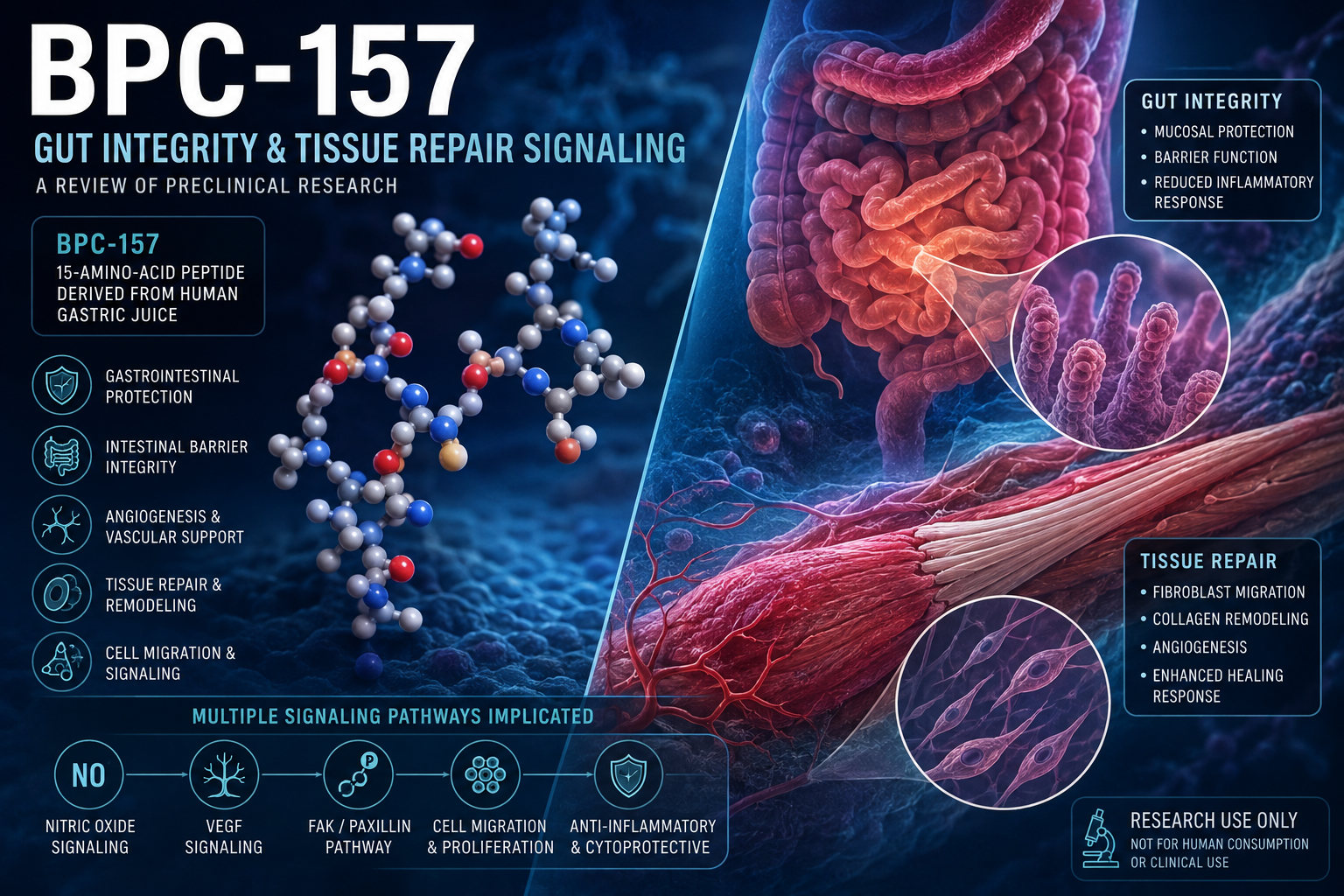
BPC-157 is a synthetic 15-amino-acid peptide that has been investigated primarily in preclinical models involving gastrointestinal protection, tissue injury, vascular signaling, inflammation, and connective-tissue repair.
Published research has reported biological activity involving several interconnected signaling systems, including nitric oxide (NO), vascular endothelial growth factor (VEGF)-related signaling, focal adhesion kinase (FAK), and paxillin.
However, the current evidence base is predominantly preclinical. Much of the literature consists of animal studies, with additional mechanistic work performed using cellular or laboratory models. Findings from these studies cannot therefore be interpreted as establishing efficacy or clinical benefit in humans.
Experimental compound
BPC-157 is primarily studied in laboratory and animal models, particularly models of gastrointestinal injury and tissue repair.
Preclinical
Human pharmacology, long-term safety, and clinically meaningful effectiveness remain insufficiently characterized.
1. Compound Overview
BPC-157 is a synthetic peptide consisting of 15 amino acids. It is associated with a peptide sequence originally identified in human gastric juice and has subsequently been investigated experimentally under the designation BPC-157.
Unlike conventional small-molecule drugs, peptides can interact with biological systems through multiple mechanisms involving receptor signaling, protein interactions, cellular migration, vascular responses, and modulation of intracellular signaling pathways. The precise molecular pharmacology of BPC-157 remains incompletely defined.
A substantial portion of the BPC-157 literature originates from experimental work investigating its effects in models of gastrointestinal injury. Subsequent studies expanded into areas including tendon and ligament injury, muscle injury, vascular responses, nervous-system injury, and inflammatory processes.
The published literature describes BPC-157 as a compound of experimental interest rather than an established therapeutic agent.
2. Molecular Targets and Proposed Mechanisms
The molecular target remains incompletely established
One important limitation in interpreting BPC-157 research is that a single definitive molecular receptor or primary pharmacological target has not been conclusively established.
The published literature instead describes interactions with several signaling systems, including nitric oxide signaling, vascular endothelial signaling, FAK/paxillin signaling, cellular migration, angiogenesis-associated pathways, and inflammatory or cytoprotective signaling.
Nitric Oxide Signaling
Experimental research has investigated interactions between BPC-157 and NO-dependent pathways involved in vascular and tissue responses.
VEGF-Related Signaling
Studies have examined vascular responses and VEGF-associated signaling in experimental tissue-injury models.
FAK / Paxillin
FAK and paxillin are associated with cellular adhesion and migration and have been investigated in tendon fibroblast models.
Cellular Migration
Experimental research has examined whether BPC-157 influences cell-migration processes involved in tissue responses to injury.
signaling
signaling
pathway
tissue response
Nitric oxide signaling
Nitric oxide is an important regulator of vascular tone, endothelial function, platelet activity, inflammation, and tissue responses to injury.
Experimental research involving BPC-157 has repeatedly investigated interactions between the peptide and the NO system. In animal models, alterations in NO-related signaling have been associated with some of the observed responses to experimental gastrointestinal and vascular injury.
These observations have contributed to the hypothesis that BPC-157's biological activity may partly involve modulation of NO-dependent pathways. This does not establish BPC-157 as a conventional nitric oxide donor, nor does it establish NO signaling as its sole mechanism.
FAK and paxillin signaling
Focal adhesion kinase (FAK) is an intracellular signaling protein associated with cell adhesion, migration, proliferation, and responses to the extracellular environment. Paxillin is an adaptor protein involved in focal adhesion complexes and cellular movement.
These pathways are relevant to tissue repair because coordinated cellular migration and adhesion are involved in many stages of tissue remodeling.
Experimental research has reported that BPC-157 can influence FAK and paxillin-related signaling in models of tissue injury.
VEGF and angiogenesis-related signaling
Vascular endothelial growth factor (VEGF) is a major regulator of angiogenesis and vascular remodeling.
BPC-157 research has investigated VEGF-associated signaling and angiogenic responses in experimental models. Some studies have reported changes in vascular responses and VEGF-related pathways following experimental exposure.
Angiogenesis-related signaling in an experimental injury model is not automatically equivalent to improved tissue function or a clinically meaningful effect in humans.
3. BPC-157 and Gastrointestinal Research
Early gastrointestinal research
Gastrointestinal research represents one of the earliest and most extensive areas of BPC-157 investigation.
Early experimental studies examined the peptide in animal models involving gastric and intestinal injury. Researchers reported observations involving gastrointestinal mucosal protection and changes in the response to experimentally induced injury.
This work formed the basis for subsequent investigations into BPC-157's effects on the gastrointestinal tract and other tissues.
Gastrointestinal mucosal integrity
The gastrointestinal mucosal barrier is a complex biological system consisting of epithelial cells, tight junctions, mucus, immune components, blood flow, and other protective mechanisms.
Experimental BPC-157 research has reported effects consistent with protection of gastrointestinal tissue in several injury models.
Some studies have examined gastric lesions and mucosal damage, while others have investigated intestinal injury and associated vascular or inflammatory responses.
The literature has therefore proposed that BPC-157 may influence multiple components of the gastrointestinal response to injury rather than acting exclusively through one mechanism.
Intestinal barrier and permeability research
Intestinal barrier function depends heavily on epithelial integrity and the regulation of intercellular junctions.
Experimental disruption of the intestinal barrier can produce increased permeability and systemic consequences. BPC-157 research has investigated intestinal injury and barrier-related responses in animal models.
Proposed mechanisms include interactions between epithelial integrity, vascular signaling, inflammatory processes, and tissue-repair pathways.
The available evidence is not sufficient to establish BPC-157 as a treatment for human intestinal permeability disorders, inflammatory bowel disease, ulcers, or other gastrointestinal conditions.
4. Tissue Repair Signaling
Tendon and ligament research
Tendon repair has become one of the better-developed areas of BPC-157 preclinical research outside the gastrointestinal system.
Tendons contain highly specialized extracellular matrices and relatively low cellularity compared with many other tissues. Their response to injury involves inflammation, cellular migration, extracellular-matrix remodeling, vascular changes, and collagen organization.
Chang and colleagues investigated BPC-157 in a rat model involving transection of the Achilles tendon. The researchers reported changes in experimental measures of tendon repair and investigated cellular mechanisms associated with the observations.
Fibroblast migration
Fibroblasts are important cells in connective-tissue repair. Following tissue injury, fibroblast migration contributes to the formation and remodeling of repair tissue.
Experimental research has reported increased migration of tendon fibroblasts following exposure to BPC-157.
The reported involvement of FAK and paxillin is particularly relevant because these proteins participate in focal adhesion formation and cell migration.
Enhanced cellular migration in a laboratory model should not automatically be interpreted as improved functional recovery in humans.
Angiogenesis and vascular responses
Vascular remodeling is another recurring theme in the BPC-157 literature.
Experimental tissue repair requires coordination between cellular activity and the vascular system. BPC-157 studies have therefore examined endothelial responses, blood-vessel formation, and VEGF-associated pathways.
Some animal studies have reported changes in vascular responses following tissue injury. The proposed interpretation is that modulation of vascular signaling could contribute to biological responses observed in experimental models.
5. Cellular and Molecular Integration
The published findings can be viewed as several interconnected research hypotheses rather than as a single established mechanism.
exposure
vascular
adhesion
remodeling
This model should be regarded as a research framework rather than a confirmed pharmacological pathway.
The literature does not currently provide sufficient evidence to conclude that every observed effect originates from one primary receptor or signaling pathway.
6. What the Published Literature Shows
7. Human Evidence and Research Gaps
The major limitation of the BPC-157 literature is the gap between extensive preclinical research and the relatively limited human evidence base.
Animal models can provide important information about biological mechanisms, but several factors complicate translation to humans, including species differences in metabolism, peptide distribution, clearance, tissue architecture, immune responses, and injury models.
A compound can produce reproducible findings in animal models without producing the same clinical outcome in humans.
8. Limitations of the Existing Evidence
Why preclinical findings require cautious interpretation
- Preclinical predominance: A substantial proportion of the literature consists of animal experiments.
- Experimental injury models: Deliberately induced injuries may not reproduce complex human diseases.
- Limited clinical validation: The available controlled human evidence remains insufficient to establish clinical effectiveness.
- Mechanistic uncertainty: Multiple pathways have been implicated, but the complete pharmacological mechanism remains unresolved.
- Independent validation: Additional independent research would strengthen confidence in reported mechanisms and reproducibility.
- Long-term safety: Adequate human safety characterization requires appropriately designed clinical studies and long-term follow-up.
9. Research Status
BPC-157 should currently be understood primarily as a compound of experimental research interest.
The literature contains substantial preclinical investigation, particularly involving gastrointestinal injury and tissue-repair models. However, the existence of numerous animal studies should not be confused with established clinical evidence.
10. Conclusion
BPC-157 has generated a substantial body of preclinical research focused on gastrointestinal protection, tissue injury, vascular responses, and cellular repair signaling.
Experimental studies have reported biological activity involving several pathways, including nitric oxide-related signaling, VEGF-associated mechanisms, and FAK/paxillin signaling. Research involving tendon fibroblasts has additionally provided evidence that cellular migration and focal-adhesion signaling may participate in some of the observed tissue responses.
The gastrointestinal literature provides another major area of investigation, with animal studies reporting changes in experimental gastric and intestinal injury models.
Despite these findings, the evidence remains predominantly preclinical. The precise molecular target of BPC-157 has not been conclusively established, and substantial questions remain regarding human pharmacology, safety, biological activity, and clinical relevance.
The published evidence supports continued scientific investigation rather than definitive conclusions about therapeutic outcomes in humans.
Experimental research context
This article is provided for scientific and educational research purposes only. BPC-157 is discussed as an experimental research compound. The information presented here does not constitute medical advice, treatment recommendations, or instructions for personal use. This review intentionally does not provide dosing, administration, cycling, stacking, procurement, or self-experimentation guidance.
References
The following references represent the primary and research literature used to contextualize the mechanisms and experimental findings discussed in this review.
- Chang CH, Lin JW, Hsu YH, et al. BPC-157 promotes the healing of transected rat Achilles tendon: involvement of FAK-paxillin pathway. Journal of Applied Physiology. 2011;110(3):774–780.
- Sikiric P, Seiwerth S, Rucman R, et al. Stable gastric pentadecapeptide BPC 157: novel therapy in gastrointestinal tract. Current Pharmaceutical Design. 2018;24(18):1990–2001.
- Experimental BPC-157 literature examining gastrointestinal mucosal injury, gastrointestinal lesions, and nitric oxide-related mechanisms in animal models.
- Experimental tendon and connective-tissue research investigating fibroblast migration, FAK/paxillin signaling, and tissue-repair responses.
- Preclinical research examining BPC-157-associated vascular responses and VEGF-related signaling in experimental injury models.
Bibliographic metadata, DOI links, PubMed identifiers, and individual study classifications should be verified against the original publisher or PubMed record before publication.