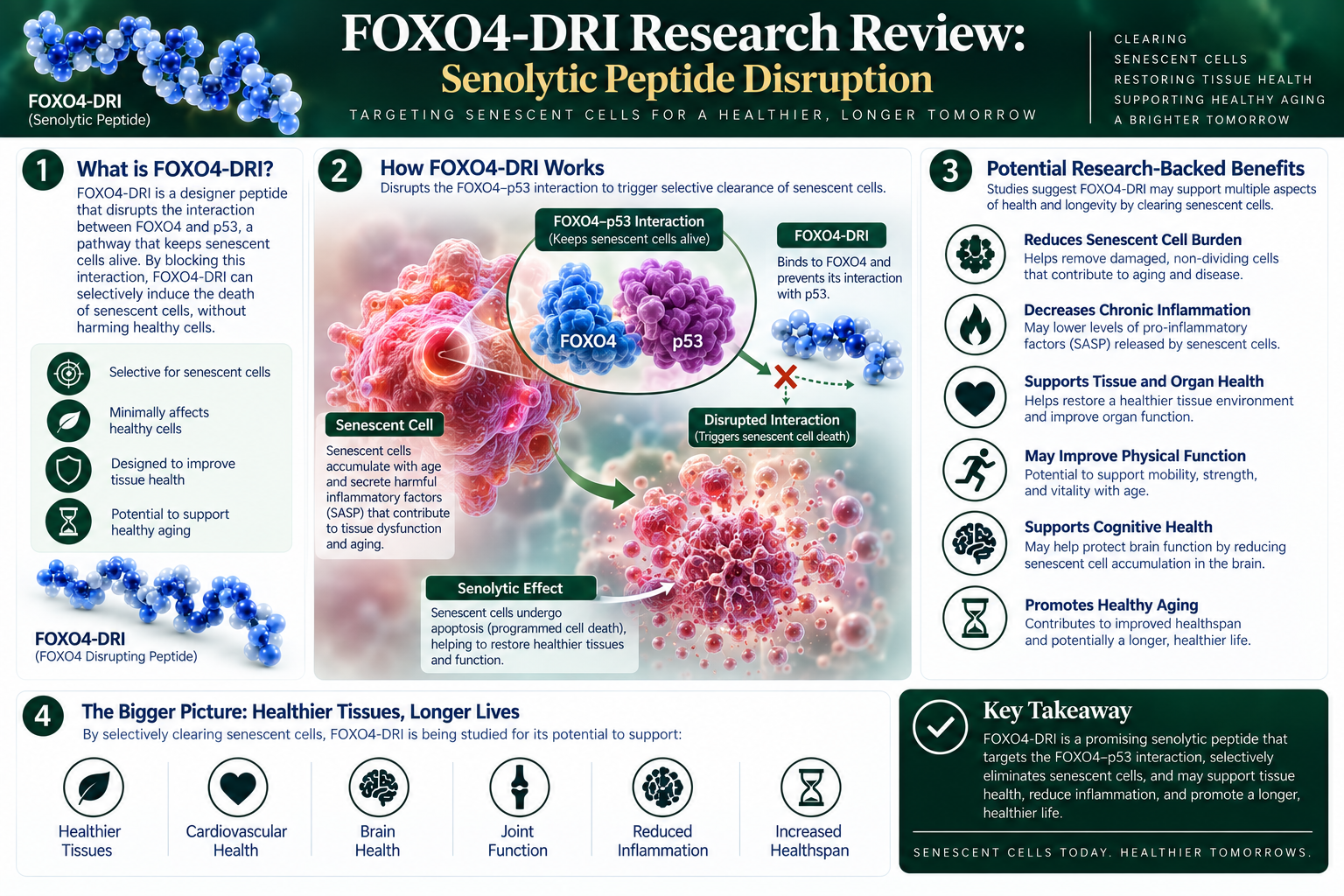
FOXO4-DRI is a synthetic D-retro-inverso peptide developed to interfere with the interaction between the transcription factor FOXO4 and the tumor-suppressor protein p53 inside senescent cells.
A central feature of senescent-cell biology is the accumulation of FOXO4, which binds and retains p53 in the nucleus, interfering with p53's normal role in triggering programmed cell death. By competitively displacing p53 from this complex, FOXO4-DRI has been investigated for its capacity to selectively eliminate senescent cells while sparing healthy, non-senescent cells.
Experimental studies have investigated FOXO4-DRI in models of chemotoxicity-induced senescence and naturally aged and fast-aging animals, examining outcomes such as fur density, renal function, and overall physical fitness. These findings have generated substantial interest in the broader field of senolytic research.
However, the majority of mechanistic and in vivo evidence remains preclinical, drawn largely from rodent models. The terminology surrounding "senolytics" as a drug class is also broad, and FOXO4-DRI's specific mechanism should not be conflated with that of unrelated senolytic compounds.
Senescent-cell apoptosis biology
The strongest mechanistic literature concerns the FOXO4-p53 interaction and its role in senescent-cell survival signaling.
Mostly preclinical
Experimental findings in rodent models do not establish that FOXO4-DRI produces equivalent effects in humans.
1. Compound Overview
FOXO4-DRI is a short synthetic peptide engineered using D-retro-inverso (DRI) technology, in which the peptide sequence is reversed and composed of D-amino acids rather than the naturally occurring L-amino acids.
This design strategy is intended to produce a peptide that retains the side-chain topology, and therefore the binding properties, of the original L-peptide sequence, while gaining substantially greater resistance to proteolytic degradation.
FOXO4-DRI was designed specifically to interfere with a protein-protein interaction implicated in senescent-cell survival: the binding of FOXO4 to p53.
The D-retro-inverso format was chosen because native L-peptides derived from FOXO4 are rapidly degraded by proteases in biological systems, limiting their usefulness as experimental tools or research probes.
2. Cellular Senescence and the SASP
Cellular senescence is a state of stable cell-cycle arrest that cells can enter in response to stressors such as DNA damage, oncogene activation, oxidative stress, or replicative exhaustion.
Senescent cells do not divide, but they remain metabolically active and often adopt a distinctive secretory profile known as the senescence-associated secretory phenotype (SASP), characterized by release of pro-inflammatory cytokines, chemokines, growth factors, and proteases.
Accumulation of senescent cells and chronic SASP signaling have been associated with tissue dysfunction and are studied extensively in the context of aging biology.
Because senescent cells resist normal apoptotic signaling, a key research question has been how these cells evade programmed cell death and whether that resistance can be selectively targeted.
3. The FOXO4–p53 Interaction
A key molecular feature identified in senescent-cell research is elevated expression of FOXO4, a forkhead-box transcription factor.
In senescent cells, FOXO4 has been reported to bind directly to p53, a transcription factor central to the regulation of apoptosis, cell-cycle arrest, and DNA-damage responses.
This FOXO4-p53 complex has been reported to retain p53 within the nucleus of senescent cells, limiting its translocation to mitochondria, where p53 can otherwise initiate mitochondrial-dependent apoptotic signaling.
Nuclear retention of p53
By sequestering p53 in the nucleus, the FOXO4-p53 interaction has been proposed as a mechanism by which senescent cells evade apoptosis and persist within tissues.
Experimental work has therefore examined whether disrupting this specific interaction could restore the normal apoptotic machinery of senescent cells without affecting non-senescent cells.
FOXO4 Elevation
Senescent cells show increased FOXO4 expression relative to non-senescent cells.
p53 Binding
FOXO4 binds p53 and has been reported to retain it within the nucleus.
Apoptotic Block
Nuclear retention limits p53's mitochondrial apoptotic signaling role.
Cell Persistence
This mechanism has been proposed to support senescent-cell survival within tissue.
4. FOXO4-DRI: Peptide-Mediated Disruption
FOXO4-DRI was designed as a competitive peptide that binds FOXO4 and interferes with its interaction with p53.
Because the peptide mimics the FOXO4 sequence region involved in p53 binding, it has been reported to competitively displace endogenous p53 from the FOXO4-p53 complex within senescent cells.
This displacement is proposed to allow p53 to exit the nucleus and translocate toward the mitochondria, where it can participate in apoptotic signaling.
Selectivity considerations
A recurring theme in the FOXO4-DRI literature is that its effects appear more pronounced in senescent cells than in non-senescent cells, which has been attributed to the differential dependency of senescent cells on the FOXO4-p53 interaction for survival.
Experimental studies have examined this selectivity using paired senescent and non-senescent cell populations under controlled conditions.
The proposed selectivity of FOXO4-DRI is mechanistically plausible given the reported dependency of senescent cells on FOXO4-p53 signaling, but selectivity observed in specific cellular models does not guarantee an identical safety profile across all tissue types or in humans.
5. Selective Apoptosis Induction
Apoptosis is a regulated form of programmed cell death that proceeds through defined intracellular signaling cascades, including mitochondrial-dependent pathways in which p53 plays a central role.
Because senescent cells characteristically resist apoptosis, research has focused on whether restoring p53 mobility through FOXO4-DRI-mediated disruption could re-enable apoptotic signaling specifically within this cell population.
Experimental studies have reported that FOXO4-DRI exposure is associated with increased markers of apoptosis in senescent cells relative to untreated senescent cells or treated non-senescent controls.
Mitochondrial signaling
Restoration of p53 mobility following FOXO4-DRI exposure has been examined in relation to mitochondrial membrane changes associated with apoptotic initiation.
These findings connect peptide-level disruption of a protein-protein interaction to downstream cellular consequences observable at the level of cell viability.
Clearance of senescent cells
Reduction in senescent-cell burden following FOXO4-DRI exposure has been reported using established senescence markers in experimental systems.
Research in this area has examined whether targeted clearance of senescent cells corresponds with changes in surrounding tissue characteristics.
binding
displacement
export
clearance
Selective apoptosis observed in experimental systems should not be interpreted as evidence of a broadly safe or clinically beneficial effect in humans.
6. Tissue and Aging Research
FOXO4-DRI has been investigated in several experimental animal models associated with senescent-cell accumulation, including models of chemotoxicity-induced senescence and naturally aged or fast-aging (progeroid) animals.
These studies have provided evidence that reducing senescent-cell burden can influence outcomes measured in animal models of aging and tissue stress.
However, the observed effects are model-dependent and should not be treated as evidence that a single mechanism explains every reported physiological outcome.
Chemotoxicity models
Chemotherapeutic exposure has been used experimentally to induce senescent-cell accumulation, allowing researchers to study whether targeted senescent-cell clearance affects chemotoxicity-related outcomes.
Some studies have reported that FOXO4-DRI exposure was associated with changes in markers of tissue stress following chemotoxic challenge in these models.
These observations have contributed to interest in senolytic peptides as tools for studying chemotoxicity-associated senescence.
Fast-aging (progeroid) models
Fast-aging animal models, which exhibit accelerated senescent-cell accumulation, have been another important experimental system for studying FOXO4-DRI.
Experimental studies in these models have examined outcomes such as fur density, general activity, and organ-function markers following FOXO4-DRI administration.
These findings are mechanistically relevant because they connect senescent-cell clearance with tissue-level and whole-animal research outcomes.
Renal function research
FOXO4-DRI has also been investigated in relation to markers of kidney function in aged and fast-aging animal models.
Research has examined processes including senescent-cell density within renal tissue and associated function markers.
Such studies broaden the research context beyond generalized fitness measures, although the results remain primarily preclinical and model-specific.
7. Mechanistic Integration
The available literature suggests that FOXO4-DRI biology is not restricted to a single downstream pathway. Instead, several processes may interact to produce the experimental outcomes reported across different models.
exposure
disruption
clearance
outcomes
A broader experimental framework can additionally include SASP reduction, changes in local inflammatory signaling, and downstream effects on surrounding non-senescent tissue.
Importantly, these mechanisms should be treated as research hypotheses supported to varying degrees by different experimental systems rather than as one fully established therapeutic pathway.
8. What the Published Literature Shows
9. Human Evidence and Translational Questions
Although senolytic research broadly has attracted substantial clinical interest, the mechanistic and in vivo literature on FOXO4-DRI specifically remains largely confined to cellular and rodent-model systems rather than definitive clinical studies.
In particular, evidence concerning selective apoptosis and senescent-cell clearance in animal models does not by itself establish a clinically meaningful outcome in humans.
Translation is further complicated by species differences in senescence biology, dosing considerations, and the distinction between research-grade peptide preparations and any future clinically developed formulations.
10. Limitations of the Existing Evidence
Why the literature requires careful interpretation
- Preclinical predominance: Much of the mechanistic literature comes from cellular and rodent-model systems rather than human clinical trials.
- Model dependence: Effects observed in one senescence model (for example, chemotoxicity-induced) may not generalize to naturally occurring age-related senescence.
- Species differences: Senescence biology and FOXO4-p53 dependency may differ between rodent models and human tissue.
- Mechanistic complexity: FOXO4-p53 disruption is one important component of the proposed mechanism, but additional pathways may contribute to experimental observations.
- Clinical translation: Senescent-cell clearance or improved fitness markers in animal models does not independently establish clinical effectiveness or safety in humans.
- Independent validation: Additional independent research is important for determining the reproducibility and translational significance of reported findings.
11. Research Status
FOXO4-DRI represents a well-characterized experimental peptide in senescent-cell biology, particularly because of its proposed mechanism of disrupting the FOXO4-p53 interaction to restore apoptotic signaling.
The literature provides a substantial mechanistic basis for studying how this peptide influences senescent-cell survival and selective clearance. Additional experimental work has connected these processes with tissue-level outcomes in several animal models of chemotoxicity and aging.
However, these findings should not be interpreted as establishing demonstrated clinical outcomes or a fully characterized safety profile in humans.
12. Conclusion
The scientific interest surrounding FOXO4-DRI is closely connected to research on senescent-cell biology, particularly the role of the FOXO4-p53 interaction in allowing senescent cells to evade apoptosis.
Peptide-mediated disruption of this interaction provides a biologically plausible mechanism for selective senescent-cell clearance, supported by cellular studies demonstrating differential effects on senescent versus non-senescent cells.
Experimental studies have extended this mechanistic framework into chemotoxicity-induced senescence models and naturally aged or fast-aging animal research, examining outcomes such as fitness, fur density, and renal function markers.
Nevertheless, the literature should be interpreted with particular attention to experimental model, species, and translational evidence. Findings involving FOXO4-DRI in animal models cannot automatically be assumed to apply to human biology or clinical use.
The strongest established research connection is between FOXO4-DRI, disruption of the FOXO4-p53 interaction, and selective apoptosis of senescent cells in experimental systems. The broader implications for human aging and tissue outcomes remain an active area of predominantly preclinical investigation.
Experimental research context
This article is provided for scientific and educational research purposes only. FOXO4-DRI is discussed as a subject of experimental research. The information presented here does not constitute medical advice, treatment recommendations, or instructions for personal use. This review intentionally does not provide dosing, administration, cycling, stacking, procurement, or self-experimentation guidance.
References
The following primary and foundational literature provides the scientific basis for the senescence, FOXO4-p53, apoptosis, and tissue research discussed in this review.
- Baar MP, Brandt RMC, Putavet DA, et al. Targeted apoptosis of senescent cells restores tissue homeostasis in response to chemotoxicity and aging. Cell. 2017;169(1):132–147.
- van Deursen JM. The role of senescent cells in ageing. Nature. 2014;509:439–446.
- Baker DJ, Wijshake T, Tchkonia T, et al. Clearance of p16Ink4a-positive senescent cells delays ageing-associated disorders. Nature. 2011;479:232–236.
- Childs BG, Durik M, Baker DJ, van Deursen JM. Cellular senescence in aging and age-related disease: from mechanisms to therapy. Nature Medicine. 2015;21(12):1424–1435.
- Kritsilis M, Rizou SV, Koutsoudaki PN, Evangelou K, Gorgoulis VG, Papadopoulos D. Ageing, cellular senescence and neurodegenerative disease. International Journal of Molecular Sciences. 2018;19(10):2937.
- Brenkman AB, de Keizer PLJ, van den Broek NJF, Jochemsen AG, Burgering BMT. Mdm2 induces mono-ubiquitination of FOXO4. PLoS ONE. 2008;3(7):e2819.
- de Keizer PLJ, Packer LM, Szypowska AA, et al. Activation of forkhead transcription factor FOXO3a by oxidative stress is mediated by the small GTPase Ral and the JNK signaling pathway. Journal of Biological Chemistry. foundational forkhead-signaling literature.
- Kirkland JL, Tchkonia T. Senolytic drugs: from discovery to translation. Journal of Internal Medicine. 2020;288(5):518–536.
- Zhang L, Pitcher LE, Prahalad V, Niedernhofer LJ, Robbins PD. Recent advances in the discovery of senolytics. Mechanisms of Ageing and Development. 2021;200:111587.
- Farr JN, Xu M, Weivoda MM, et al. Targeting cellular senescence prevents age-related bone loss in mice. Nature Medicine. 2017;23:1072–1079.
Before publication, bibliographic metadata, page ranges, DOI information, PubMed identifiers, and study classifications should be checked against the original publisher or PubMed record. Particular care should be taken to distinguish primary FOXO4-DRI research from broader senolytic-field reviews and from research involving unrelated senolytic compound classes.