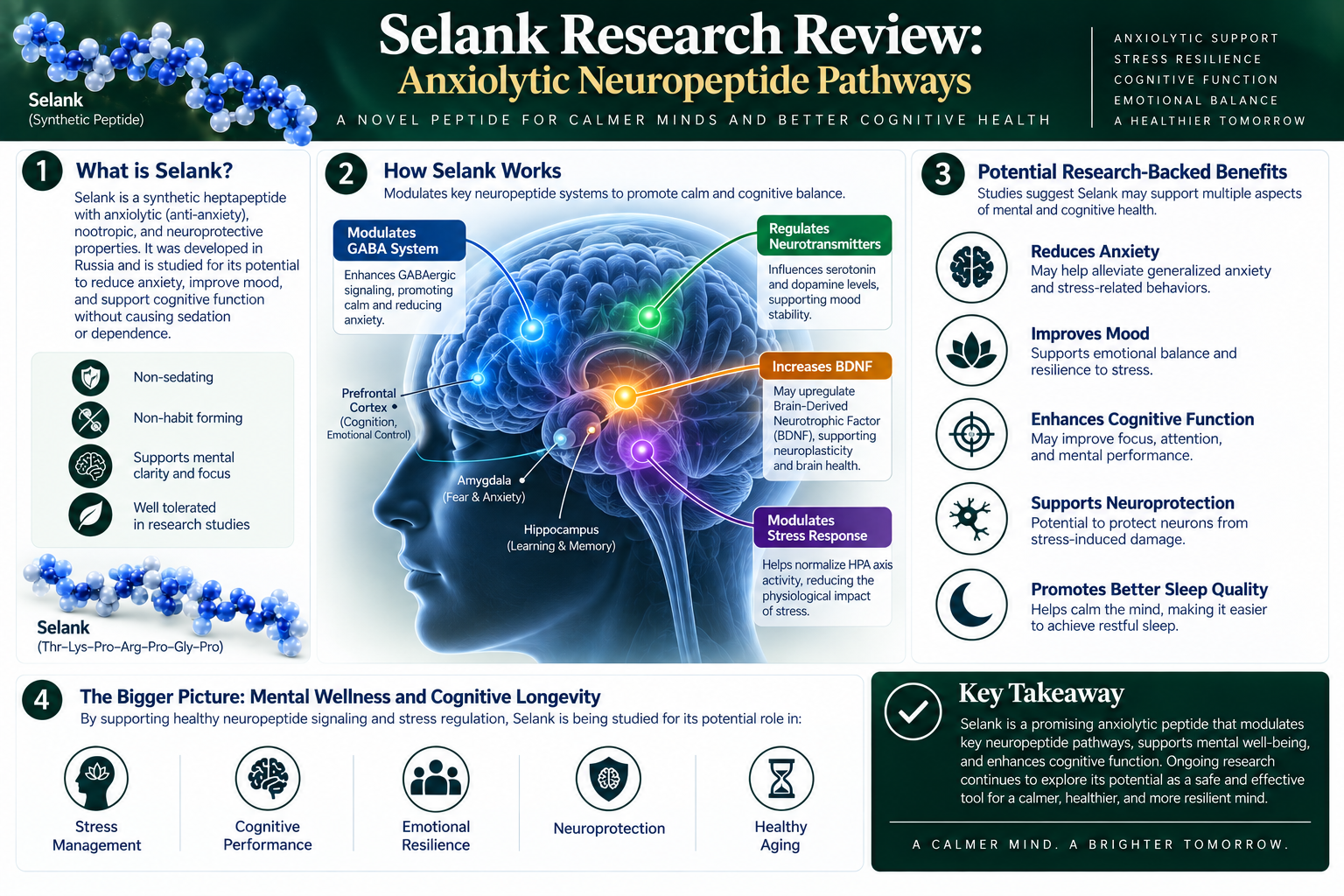
Selank is a synthetic heptapeptide developed as an analog of tuftsin, an endogenous tetrapeptide fragment of immunoglobulin G. It was designed to reproduce and extend certain properties associated with tuftsin while offering greater enzymatic stability.
A central feature of Selank research is its investigated relationship with anxiolytic-type behavioral responses in animal models. Experimental studies have examined Selank in standardized rodent anxiety paradigms and in relation to several neurochemical systems implicated in stress and emotional regulation.
Experimental studies have also investigated Selank in connection with GABAergic signaling, monoamine (serotonergic and dopaminergic) systems, enkephalinase inhibition, and expression of brain-derived neurotrophic factor (BDNF). These findings have generated interest in its potential role in stress-response and neuroadaptive biology.
However, the majority of behavioral and neurochemical evidence remains preclinical, drawn largely from Russian pharmacological research programs, and the terminology surrounding tuftsin, Selank, and related synthetic analogs should be kept distinct when comparing studies.
Tuftsin-analog neuropeptide biology
The strongest mechanistic literature concerns Selank as a synthetic tuftsin analog and its interaction with neurochemical systems associated with anxiety-type behavior.
Mostly preclinical
Experimental findings do not establish that commercially available Selank produces defined anxiolytic or cognitive effects in general human populations.
1. Compound Overview
Selank is a synthetic heptapeptide with the sequence Thr-Lys-Pro-Arg-Pro-Gly-Pro, developed by extending the tetrapeptide tuftsin with an additional proline-glycine-proline sequence intended to increase resistance to enzymatic degradation.
Tuftsin itself is a naturally occurring tetrapeptide fragment released from the Fc region of immunoglobulin G and has been studied for its interactions with immune cell receptors. Selank was developed within a distinct research tradition focused on behavioral and neurochemical properties rather than immune function.
The biological interest in Selank centers on its investigated role across several interconnected neurochemical systems, including GABAergic transmission, monoamine metabolism, enkephalinase inhibition, and neurotrophic factor expression, all of which have been examined in relation to anxiety-type behavioral outcomes in animal models.
Foundational literature on tuftsin describes a naturally occurring immune-related tetrapeptide. Selank is a distinct synthetic heptapeptide developed as a stabilized structural extension of tuftsin, and product identity and purity should not be assumed without analytical characterization.
2. Selank and Tuftsin
A major consideration when reviewing the literature is the distinction between tuftsin, the naturally occurring immunomodulatory tetrapeptide, and Selank, the synthetic heptapeptide analog developed from it.
The earlier body of tuftsin literature primarily describes immune-cell interactions, including effects on phagocytic activity. Selank was engineered as a structurally extended, more enzymatically stable derivative, and its research program shifted focus toward central nervous system and behavioral endpoints.
Consequently, experimental findings obtained with tuftsin should not automatically be treated as direct evidence for Selank, and the reverse is also true, given the differences in structure, stability, and the biological systems each has been studied in.
This distinction is particularly important when evaluating claims about molecular mechanism, receptor interactions, behavioral effects, or translational relevance.
3. Neurochemical Mechanisms
Experimental research on Selank has examined its relationship with several neurochemical systems that are individually associated with mood, arousal, and stress regulation.
Rather than describing a single receptor-mediated mechanism, the literature presents Selank as a compound with reported effects across multiple interconnected pathways, which together have been proposed to contribute to its behavioral profile in animal studies.
GABAergic signaling
Gamma-aminobutyric acid (GABA) is the principal inhibitory neurotransmitter in the mammalian central nervous system and is central to the pharmacology of many anxiolytic compounds.
Experimental studies have examined whether Selank exposure influences GABAergic tone or related receptor expression in brain regions associated with anxiety-type behavior.
Enkephalinase inhibition
Enkephalinases are enzymes that degrade endogenous enkephalins, short opioid peptides involved in pain and stress modulation.
Selank has been investigated for its potential to inhibit enkephalin-degrading enzymes, a mechanism proposed to prolong the activity of endogenous enkephalin signaling in experimental systems.
GABAergic Tone
Selank has been investigated for its association with GABAergic signaling in brain regions linked to anxiety-type behavior.
Enkephalinase Inhibition
Proposed inhibition of enkephalin-degrading enzymes may prolong endogenous opioid-peptide signaling in experimental models.
Monoamine Systems
Serotonergic and dopaminergic signaling have been examined in relation to Selank-associated behavioral changes.
Neurotrophic Signaling
BDNF-related gene expression has been studied as a possible downstream component of Selank's neurochemical profile.
4. Anxiolytic-Type Behavioral Research
A substantial portion of the Selank literature involves standardized rodent behavioral paradigms used to assess anxiety-type responses, such as elevated plus-maze and open-field testing.
Because these paradigms measure defined behavioral endpoints under controlled laboratory conditions, they allow researchers to compare Selank's effects to those of established reference anxiolytic compounds within the same experimental framework.
Experimental studies have reported changes in these behavioral measures following Selank administration in various rodent strains and stress-induction protocols.
Stress-response models
Some experimental designs have combined acute or chronic stress-induction procedures with Selank administration to examine whether the peptide modifies stress-related behavioral or physiological outcomes.
These studies have contributed to a broader research narrative proposing Selank as a compound of interest for studying stress-adaptation biology, distinct from claims about defined therapeutic effects.
Comparative pharmacology
A number of studies have directly compared Selank's behavioral profile in rodent models to that of benzodiazepine or other reference anxiolytic compounds, examining both behavioral outcomes and reported differences in sedation or motor impairment.
The relationship between Selank, GABAergic and monoaminergic signaling, and anxiety-type behavior provides a mechanistic basis for investigating its role in stress-response biology, but rodent behavioral paradigms do not by themselves establish a defined anxiolytic effect in humans.
5. BDNF and Neurotrophic Signaling
Brain-derived neurotrophic factor (BDNF) is a signaling protein involved in neuronal survival, synaptic plasticity, and adaptive responses to stress, and has been widely studied in connection with mood-related behavior in animal models.
Experimental Selank studies have examined whether peptide exposure influences BDNF gene expression in specific brain regions, situating the research within a broader framework connecting neurotrophic signaling to stress adaptation.
Reported changes in BDNF-related gene expression following Selank administration have been proposed as one possible downstream contributor to the behavioral findings described in the anxiolytic-research literature.
Gene-expression studies
Molecular studies in rodent brain tissue have examined Selank's association with expression of BDNF and related genes involved in synaptic plasticity.
These findings remain at an early, largely descriptive stage and require further mechanistic characterization to establish causal relationships.
Integration with behavioral findings
Some studies have attempted to relate BDNF-related molecular changes to the behavioral outcomes observed in anxiety-type paradigms, though the strength and consistency of this relationship varies across the literature.
signaling
modulation
signaling
response
Behavioral or neurochemical changes observed in rodent experimental systems should not be interpreted as evidence of a defined anxiolytic or cognitive benefit in humans.
6. Mechanistic Integration
The available literature suggests that Selank's investigated biology is not restricted to a single neurochemical pathway. Instead, GABAergic modulation, enkephalinase inhibition, monoamine signaling, and BDNF-related gene expression may interact to produce the behavioral responses reported across different experimental models.
signaling
inhibition
monoamines
response
A broader experimental framework can additionally include hypothalamic-pituitary-adrenal axis signaling, neuroimmune interactions, and other stress-response pathways proposed in various Selank studies.
Importantly, these mechanisms should be treated as research hypotheses supported to varying degrees by different experimental systems rather than as one fully established neurochemical pathway.
7. What the Published Literature Shows
8. Human Evidence and Translational Questions
Although Selank has been examined in some human research contexts within specific regional pharmacological programs, the mechanistic and behavioral literature remains substantially broader in rodent experimental systems than in definitive, independently replicated clinical studies.
In particular, neurochemical or behavioral changes observed in rodent models do not by themselves establish a clinically meaningful anxiolytic or cognitive outcome in humans.
Translation is further complicated by variability in study design, regional differences in research and regulatory traditions, and the distinction between experimental Selank preparations and commercially available products.
9. Limitations of the Existing Evidence
Why the literature requires careful interpretation
- Selank/tuftsin distinction: Tuftsin and Selank are structurally and functionally distinct, and findings for one should not be assumed to apply to the other.
- Preclinical predominance: Much of the mechanistic and behavioral literature comes from rodent models using standardized anxiety-type paradigms.
- Research concentration: A substantial share of the published literature originates from a limited number of research groups, which affects the breadth of independent replication.
- Mechanistic complexity: GABAergic, monoaminergic, enkephalinase, and neurotrophic pathways are each individually studied, but their relative contribution to any overall effect is not fully resolved.
- Clinical translation: Rodent behavioral changes or gene-expression findings do not independently establish clinical effectiveness in humans.
- Independent validation: Additional independent research is important for determining the reproducibility and translational significance of reported findings.
10. Research Status
Selank represents a well-studied experimental peptide within regional pharmacological research traditions, particularly because of its origin as a stabilized tuftsin analog and its investigated relationship with multiple neurochemical systems implicated in anxiety-type behavior.
The literature provides a mechanistic basis for studying how Selank may influence GABAergic tone, enkephalinase activity, monoamine signaling, and BDNF-related gene expression. Additional experimental work has connected these processes with standardized rodent behavioral paradigms.
However, these findings should not be interpreted as establishing equivalent effects for all commercially available Selank products or as demonstrating established clinical outcomes in humans.
11. Conclusion
The scientific interest surrounding Selank is closely connected to its origin as a stabilized synthetic analog of tuftsin and to its investigated interactions with several neurochemical systems implicated in anxiety-type behavior.
GABAergic modulation, enkephalinase inhibition, and monoamine signaling together provide a biologically plausible, if not fully unified, framework connecting Selank to stress-response biology, while BDNF-related findings extend this framework into neurotrophic signaling.
Experimental studies have extended this research into standardized rodent behavioral paradigms and comparative pharmacology against reference anxiolytic compounds.
Nevertheless, the literature should be interpreted with particular attention to experimental model, preparation identity, and translational evidence. Findings involving experimental Selank preparations cannot automatically be attributed to every commercially available product.
The strongest established research connection is between Selank, its tuftsin-derived origin, and its investigated effects across GABAergic, monoaminergic, and enkephalinase- related signaling in rodent models. The broader implications for human anxiety and stress-response biology remain an active area of predominantly preclinical investigation.
Experimental research context
This article is provided for scientific and educational research purposes only. Selank and tuftsin are discussed as subjects of experimental research. The information presented here does not constitute medical advice, treatment recommendations, or instructions for personal use. This review intentionally does not provide dosing, administration, cycling, stacking, procurement, or self-experimentation guidance.
References
The following primary and foundational literature provides the scientific basis for the neurochemical, behavioral, and neurotrophic research discussed in this review.
- Kozlovskaya MM, Kozlovskii II, Val'dman EA, et al. Novel non-benzodiazepine anxiolytics based on the peptide Selank. Experimental and Clinical Pharmacology / Russian pharmacological literature.
- Semenova TP, Kozlovskaya MM. Selank and its effects on emotional and behavioral responses in rodent stress models. Neuroscience and Behavioral Physiology.
- Inozemtseva LS, Karpenko EA, Dolotov OV, et al. Selank inhibits the degradation of enkephalins and modulates enkephalinase activity in experimental systems. Bulletin of Experimental Biology and Medicine.
- Kolyasnikova KN, Vasil'eva EV, Zozulya AA, et al. Neurochemical mechanisms of the anxiolytic action of Selank. Bulletin of Experimental Biology and Medicine.
- Volkova A, Shadrina M, Kolomin T, et al. Selank administration affects gene expression of brain- derived neurotrophic factor and related genes in rodent brain tissue. Molecular Genetics, Microbiology and Virology / related molecular biology literature.
- Kolomin T, Shadrina M, Slominsky P, Andreeva L, Myasoedov N. Prospects for Selank: neuropeptide regulation of gene expression in stress-response research. Doklady Biochemistry and Biophysics.
- Zozulya AA, Neznamov GG, Siuniakov TS, et al. Comparative study of the effects of Selank and reference anxiolytic compounds on anxiety-type outcomes. Psychopharmacology / Russian clinical pharmacology literature.
- Medvedeva EV, Dmitrieva VG, Povarnina PY, et al. Selank and related tuftsin-based peptides in neuroprotective and neurotrophic experimental models. Acta Naturae / neuroscience research literature.
- Nezavibatko VN, Kozlovskaya MM, Zozulya AA, et al. Development of Selank as a stabilized tuftsin-derived heptapeptide with behavioral pharmacological activity. Foundational peptide-design and pharmacology literature.
- Kost NV, Sokolov OY, Gabaeva MV, Grivennikov IA, Andreeva LA, Myasoedov NF. Tuftsin-derived peptides and their opioid-related and enkephalinase-inhibitory properties in experimental systems. Peptides.
Before publication, bibliographic metadata, page ranges, DOI information, PubMed identifiers, and study classifications should be checked against the original publisher or PubMed record. Particular care should be taken to distinguish primary Selank research from later reviews and from research involving tuftsin or other structurally related peptides.