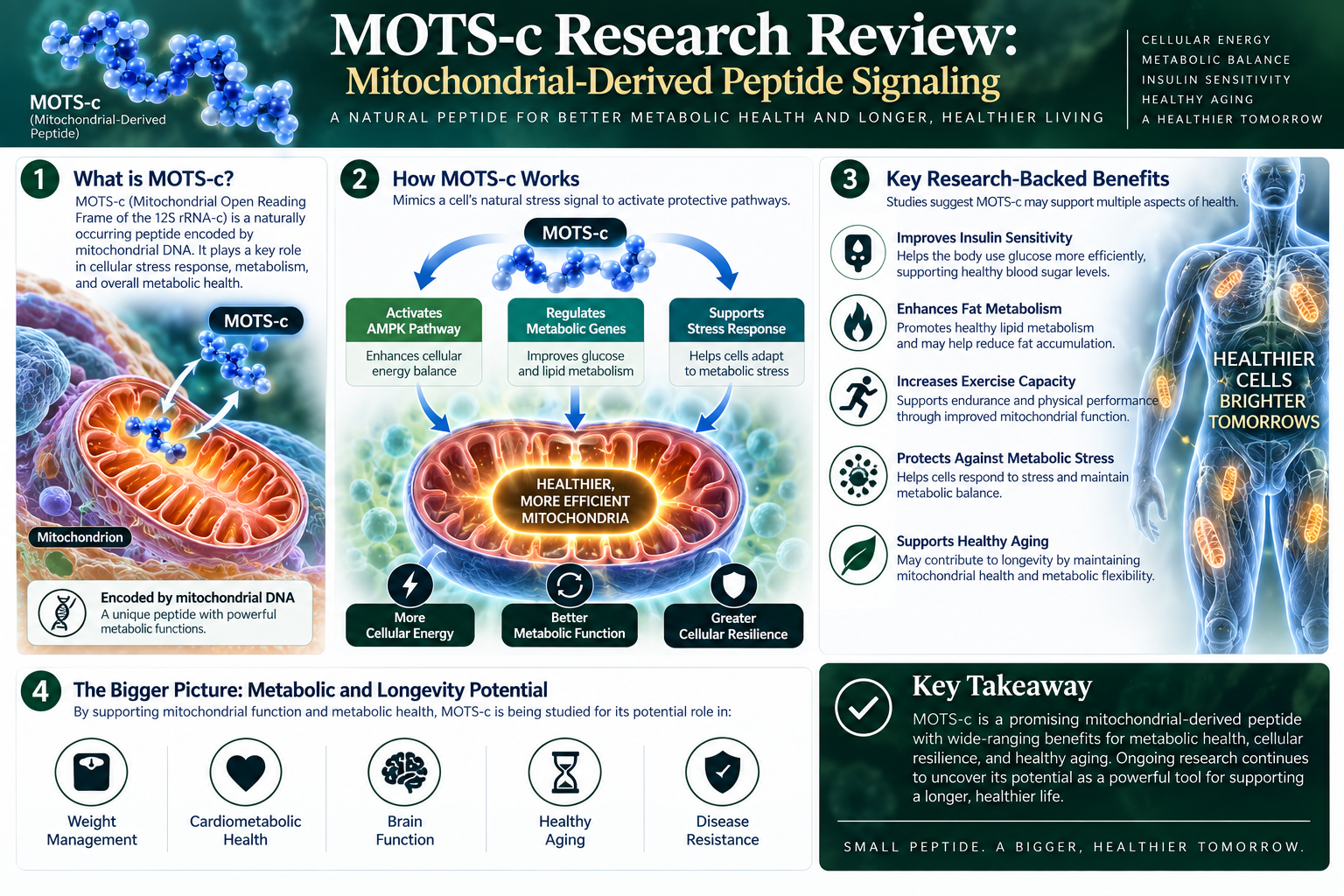
MOTS-c is a 16-amino-acid peptide encoded within the mitochondrial genome, specifically within a short open reading frame located in the 12S rRNA region. It belongs to a small class of signaling molecules referred to as mitochondrial-derived peptides.
A central feature of MOTS-c research is its investigated relationship with AMPK (AMP-activated protein kinase), a cellular energy-sensing enzyme. Experimental studies have examined whether MOTS-c exposure activates AMPK-dependent signaling and influences downstream metabolic gene expression.
Experimental studies have also investigated MOTS-c in relation to glucose and lipid metabolism, insulin sensitivity, mitochondrial-nuclear communication, and exercise-induced adaptation in skeletal muscle. These findings have generated interest in its potential role in metabolic and exercise biology.
However, the majority of mechanistic and metabolic evidence remains preclinical, drawn primarily from cell-culture and rodent models, and terminology around MOTS-c as a naturally occurring peptide versus synthetically produced research material should be kept distinct when comparing studies.
Mitochondrial-derived peptide biology
The strongest mechanistic literature concerns MOTS-c as an endogenous mitochondrial signaling peptide and its interaction with AMPK-dependent metabolic pathways.
Mostly preclinical
Experimental findings do not establish that synthetic MOTS-c research material produces defined metabolic or clinical effects in humans.
1. Compound Overview
MOTS-c is one of a small number of identified mitochondrial- derived peptides, meaning it is encoded by mitochondrial DNA rather than the nuclear genome. It was identified within an alternative open reading frame of the mitochondrial 12S rRNA gene.
Unlike many peptides studied for tissue-repair or growth-related effects, MOTS-c research is centered on cellular energy metabolism. Its discovery contributed to a broader research framework describing the mitochondrion not only as an energy-producing organelle but also as a signaling source that communicates with the nucleus and other cellular compartments.
This mitochondrial-nuclear communication concept underlies much of the interest in MOTS-c as a research tool for studying metabolic regulation, cellular stress responses, and age-associated metabolic changes.
Foundational research describes MOTS-c as an endogenous peptide produced from mitochondrial DNA in human and animal cells. Synthetic MOTS-c used in research settings is manufactured to replicate this sequence, and product identity and purity should not be assumed without independent verification.
2. Mitochondrial Origin and Mitochondrial-Derived Peptides
A major consideration when reviewing the literature is understanding what distinguishes MOTS-c from more conventionally studied peptide hormones encoded by nuclear genes.
Mitochondrial-derived peptides, including MOTS-c and related peptides such as humanin, are encoded within short reading frames of mitochondrial DNA that were historically overlooked in genome annotation. Their identification reframed the mitochondrial genome as a source of signaling molecules in addition to its established role in oxidative phosphorylation.
Because MOTS-c is produced endogenously and can also localize to the nucleus under certain cellular stress conditions, it has been proposed as a messenger connecting mitochondrial status to nuclear gene expression.
This distinction is particularly important when evaluating claims about molecular mechanism, tissue distribution, endogenous regulation, and how closely synthetic research material mirrors the naturally produced peptide.
3. AMPK Signaling
The central molecular feature most associated with MOTS-c research is its investigated relationship with AMPK, a heterotrimeric enzyme that functions as a key sensor of cellular energy status.
AMPK is activated when the ratio of AMP to ATP rises within a cell, signaling reduced energy availability. Once activated, AMPK promotes catabolic processes that generate ATP while suppressing energy-consuming anabolic processes.
Because AMPK sits at the center of cellular energy homeostasis, compounds that influence its activation state have drawn interest in experimental metabolic research.
AMPK activation studies
Experimental studies in cultured cells and rodent models have reported that MOTS-c exposure was associated with activation of AMPK signaling and downstream changes in metabolic gene expression.
The functional significance of this observation is of interest because AMPK activation is connected to processes including glucose uptake, fatty-acid oxidation, and mitochondrial biogenesis in various tissues.
AMPK Activation
MOTS-c has been investigated for its association with AMPK pathway activation in cultured cell and animal models.
Nuclear Signaling
Under certain stress conditions, MOTS-c has been reported to translocate to the nucleus and influence gene expression.
Energy Sensing
AMPK-related signaling links MOTS-c research to broader cellular energy-homeostasis pathways.
Metabolic Gene Expression
Downstream changes in metabolic gene expression have been examined following MOTS-c exposure in experimental models.
4. Metabolic Regulation
Beyond AMPK activation itself, a substantial portion of MOTS-c research has focused on downstream metabolic outcomes, including glucose handling, lipid metabolism, and insulin sensitivity in animal models.
Because these processes are tightly interconnected with cellular energy status, compounds that influence AMPK signaling can potentially affect broader whole-body metabolic parameters.
Experimental research has investigated MOTS-c administration in rodent models of diet-induced obesity and age-related insulin resistance, examining measures such as glucose tolerance and body composition.
Glucose and lipid handling
Rodent studies have reported that MOTS-c administration was associated with changes in glucose tolerance and measures of lipid metabolism under specific experimental conditions.
These findings have been interpreted within the broader context of AMPK-related metabolic signaling rather than as evidence of a single isolated mechanism.
Insulin sensitivity
Age-related and diet-induced insulin resistance models have been used to examine whether MOTS-c-associated signaling changes insulin-related outcomes in experimental animals.
Findings in this area remain an active area of preclinical research and are not uniform across all experimental models.
The relationship between MOTS-c, AMPK signaling, and metabolic outcomes provides a mechanistic basis for investigating its role in metabolic-aging biology, but rodent metabolic findings do not by themselves establish a defined metabolic benefit in humans.
5. Exercise Adaptation and Skeletal Muscle
Skeletal muscle is a tissue with substantial mitochondrial content and energy demand, making it a natural focus for MOTS-c research given its mitochondrial origin and AMPK-related signaling.
Experimental studies have examined whether endogenous MOTS-c expression changes in response to exercise, and whether MOTS-c administration influences exercise capacity or muscle metabolic adaptation in animal models.
Some rodent studies have reported associations between MOTS-c and measures of exercise performance or muscle metabolic gene expression, contributing to interest in the peptide as a research tool for studying exercise-adaptation biology.
Endogenous exercise response
Research has examined whether circulating or tissue MOTS-c levels change in response to physical activity, situating the peptide within a broader framework of exercise-induced mitochondrial signaling.
These observations remain associative in nature and require further mechanistic characterization.
Muscle metabolic gene expression
Experimental administration studies have examined downstream changes in skeletal-muscle gene-expression programs associated with mitochondrial function and substrate utilization.
These findings connect MOTS-c-associated AMPK signaling with a tissue system in which metabolic adaptation can be measured directly.
peptide
activation
adaptation
whole-body
Exercise-related or metabolic changes observed in rodent experimental systems should not be interpreted as evidence of a defined performance or metabolic benefit in humans.
6. Mechanistic Integration
The available literature suggests that MOTS-c biology is not restricted to a single downstream pathway. Instead, AMPK activation, nuclear signaling, and tissue-specific metabolic responses may interact to produce the experimental outcomes reported across different models.
production
sensing
expression
response
A broader experimental framework can additionally include stress-response signaling, mitochondrial-nuclear communication more generally, and age-associated changes in endogenous MOTS-c production that have been proposed in various studies.
Importantly, these mechanisms should be treated as research hypotheses supported to varying degrees by different experimental systems rather than as one fully established therapeutic pathway.
7. What the Published Literature Shows
8. Human Evidence and Translational Questions
Although circulating MOTS-c has been measured in some human observational research, the mechanistic and metabolic-outcome literature remains substantially broader in cell-culture and rodent systems than in definitive human interventional studies.
In particular, AMPK activation and metabolic gene-expression changes observed in cultured cells or rodent tissue do not by themselves establish a clinically meaningful metabolic or exercise-performance outcome in humans.
Translation is further complicated by the distinction between naturally produced endogenous MOTS-c and synthetically manufactured research material used in experimental administration studies.
9. Limitations of the Existing Evidence
Why the literature requires careful interpretation
- Endogenous vs. synthetic distinction: Naturally produced MOTS-c and synthetic research peptide are not automatically interchangeable in every experimental context.
- Preclinical predominance: Much of the mechanistic literature comes from cell-culture and rodent models, particularly in metabolic and exercise research.
- Model dependence: Effects observed in one tissue, cell line, or animal strain may not generalize to another biological system.
- Mechanistic complexity: AMPK activation is one important component of MOTS-c biology, but additional signaling pathways may contribute to experimental observations.
- Clinical translation: Rodent metabolic changes or in vitro AMPK activation do not independently establish clinical effectiveness in humans.
- Independent validation: Additional independent research is important for determining the reproducibility and translational significance of reported findings.
10. Research Status
MOTS-c represents a comparatively recently characterized experimental peptide in mitochondrial and metabolic biology, particularly because of its mitochondrial-DNA origin and its proposed relationship with AMPK signaling.
The literature provides a mechanistic basis for studying how MOTS-c may influence cellular energy sensing and downstream metabolic gene expression. Additional experimental work has connected these processes with skeletal-muscle exercise adaptation and rodent models of metabolic dysfunction.
However, these findings should not be interpreted as establishing equivalent effects for all synthetic MOTS-c research material or as demonstrating established clinical outcomes in humans.
11. Conclusion
The scientific interest surrounding MOTS-c is closely connected to its unusual origin as a peptide encoded within mitochondrial DNA, and to its proposed role in activating AMPK-dependent energy- sensing signaling.
AMPK activation provides a biologically plausible connection between MOTS-c and metabolic regulation because cellular energy sensing sits upstream of glucose handling, lipid metabolism, and mitochondrial biogenesis.
Experimental studies have extended this mechanistic framework into rodent models of metabolic dysfunction, insulin resistance, and skeletal-muscle exercise adaptation.
Nevertheless, the literature should be interpreted with particular attention to experimental model, peptide source, and translational evidence. Findings involving endogenous mitochondrial-derived MOTS-c cannot automatically be attributed to every synthetic research preparation.
The strongest established research connection is between MOTS-c, AMPK pathway activation, and cellular energy-sensing signaling. The broader implications for metabolic health, exercise adaptation, and aging remain an active area of predominantly preclinical investigation.
Experimental research context
This article is provided for scientific and educational research purposes only. MOTS-c is discussed as a subject of experimental research. The information presented here does not constitute medical advice, treatment recommendations, or instructions for personal use. This review intentionally does not provide dosing, administration, cycling, stacking, procurement, or self-experimentation guidance.
References
The following primary and foundational literature provides the scientific basis for the mitochondrial-signaling, AMPK, metabolic, and exercise research discussed in this review.
- Lee C, Zeng J, Drew BG, et al. The mitochondrial-derived peptide MOTS-c promotes metabolic homeostasis and reduces obesity and insulin resistance. Cell Metabolism. 2015;21(3):443–454.
- Lu H, Wei M, Zhai Y, et al. MOTS-c peptide regulates adipose homeostasis to prevent ovariectomy-induced metabolic dysfunction. Journal of Molecular Medicine. 2019;97(4):473–485.
- Reynolds JC, Lai RW, Woodhead JST, et al. MOTS-c is an exercise-induced mitochondrial-encoded regulator of age-dependent physical decline and muscle homeostasis. Nature Communications. 2021;12:470.
- Kim KH, Son JM, Benayoun BA, Lee C. The mitochondrial-encoded peptide MOTS-c translocates to the nucleus to regulate nuclear gene expression in response to metabolic stress. Cell Metabolism. 2018;28(3):516–524.
- Zhang Y, Wang L, Wu Z, Yu X, Li X, Chu J. Mitochondrial-derived peptide MOTS-c: effects and mechanisms related to metabolic disease. Frontiers in Physiology. 2021;12:645902.
- Fuku N, Pareja-Galeano H, Zempo H, et al. The mitochondrial-derived peptide MOTS-c: a player in exceptional longevity? Aging Cell. 2015;14(6):921–923.
- Ramanjaneya M, Bettahi I, Jerobin J, et al. Mitochondrial-derived peptides are down regulated in obesity and diabetes and are associated with insulin sensitivity. Frontiers in Endocrinology. 2019;10:331.
- Kumagai H, Coelho AR, Wan J, et al. MOTS-c reduces myostatin and muscle atrophy signaling. American Journal of Physiology-Endocrinology and Metabolism. 2021;320(4):E680–E690.
- Yin X, Jing Y, Chen Q, et al. The mitochondrial-derived peptide MOTS-c relieves cardiomyocyte hypoxia/reoxygenation injury via AMPK activation. Experimental cardiovascular research literature.
- Reynolds JC, Bwiza CP, Lee C. Mitonuclear genomics and aging: MOTS-c and mitochondrial- derived peptides in physiological regulation. Review literature on mitochondrial-derived peptide biology.
Before publication, bibliographic metadata, page ranges, DOI information, PubMed identifiers, and study classifications should be checked against the original publisher or PubMed record. Particular care should be taken to distinguish primary MOTS-c research from later reviews and from research involving other mitochondrial-derived peptides.