Epitalon, also referred to in the literature as Epithalon or Epithalone, is a synthetic tetrapeptide (Ala-Glu-Asp-Gly) modeled on epithalamin, a polypeptide extract originally isolated from the pineal gland and studied extensively in Russian gerontological research.
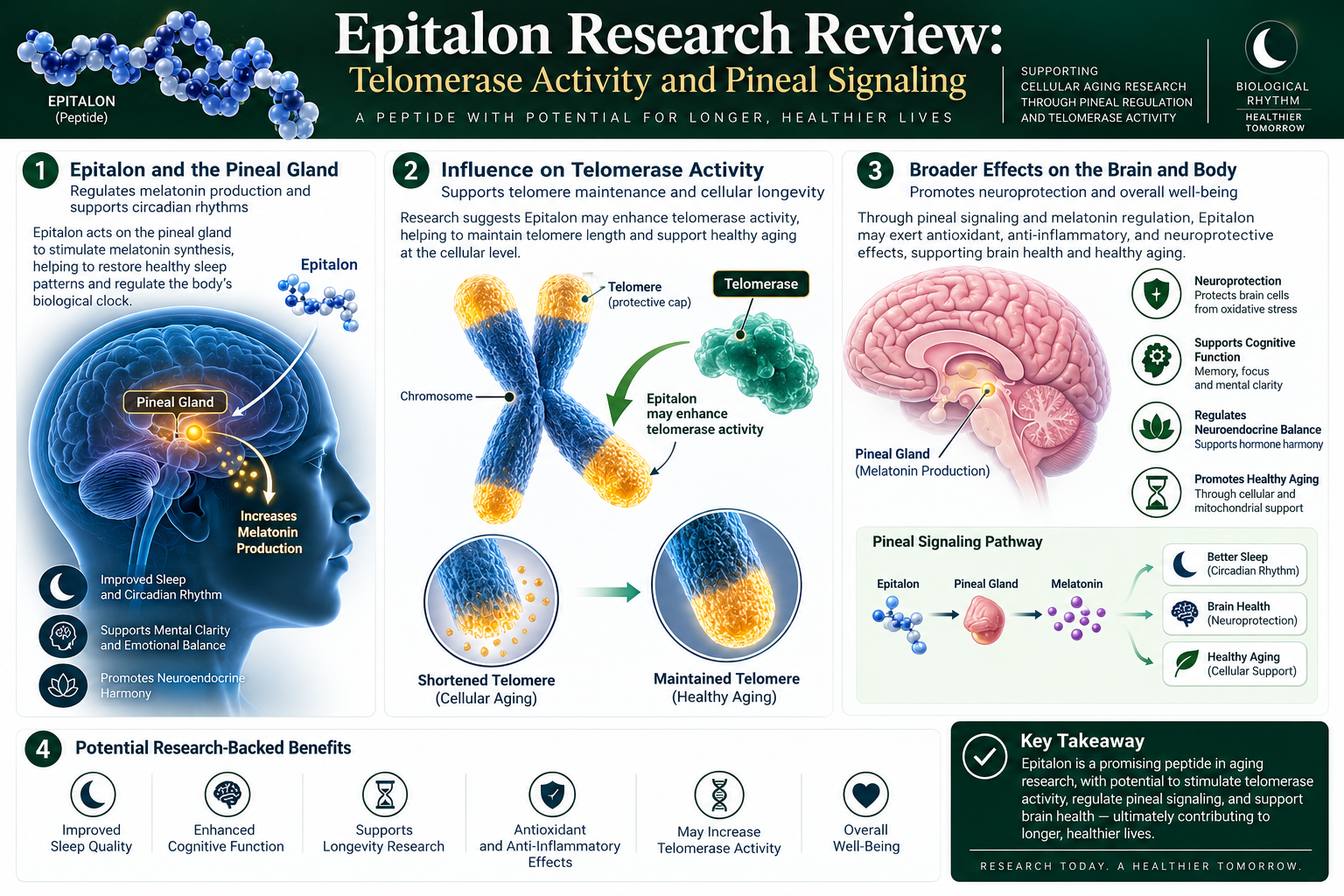
A central feature of Epitalon research is its investigated relationship with telomerase, the enzyme responsible for maintaining telomere length at the ends of chromosomes. Experimental studies have examined whether Epitalon exposure influences telomerase gene expression in cultured human somatic cells.
Alongside this chromosomal research, a separate but related body of literature has investigated Epitalon in connection with pineal gland function, melatonin secretion, and circadian regulation, reflecting its origin as a synthetic analog of a pineal-derived peptide preparation.
However, the majority of both the telomerase and the pineal signaling evidence remains preclinical, and the terminology surrounding Epitalon, Epithalon, and epithalamin is used inconsistently across sources, making careful comparison between studies important.
Pineal peptide biology
The strongest mechanistic literature concerns Epitalon as a synthetic tetrapeptide analog of epithalamin and its interaction with telomerase-related gene expression.
Mostly preclinical
Experimental findings do not establish that Epitalon produces defined telomerase, pineal, or lifespan effects in general human populations.
1. Compound Overview
Epitalon is a short synthetic peptide consisting of four amino acids: alanine, glutamic acid, aspartic acid, and glycine. It was developed as a simplified synthetic analog of epithalamin, a polypeptide complex extracted from bovine pineal tissue and studied for several decades in experimental gerontology.
The biological interest in Epitalon spans two overlapping areas of research: its proposed influence on telomerase gene expression in somatic cells, and its investigated role in pineal gland signaling, including melatonin secretion and circadian rhythm regulation.
These two research threads are mechanistically distinct but are frequently discussed together because both are framed within a broader research narrative concerning neuroendocrine aging and cellular senescence.
Foundational research on the pineal peptide complex generally refers to epithalamin, an extracted polypeptide preparation. "Epitalon" and "Epithalon" refer to the synthetic tetrapeptide analog, and product identity should not be assumed equivalent to epithalamin extracts without analytical characterization.
2. Epitalon and Epithalamin
A major consideration when reviewing the literature is the distinction between epithalamin and compounds described as Epitalon or Epithalon.
The earlier body of Russian gerontological literature primarily describes epithalamin, a polypeptide extract containing multiple peptide fractions. By contrast, Epitalon is a single defined synthetic tetrapeptide intended to reproduce a portion of epithalamin's proposed activity.
Consequently, experimental findings obtained with the extracted polypeptide complex should not automatically be treated as direct evidence for the isolated synthetic tetrapeptide, and vice versa.
This distinction is particularly important when evaluating claims about molecular mechanism, telomerase activity, pineal function, or lifespan-related outcomes.
3. Telomerase Activity
The central molecular feature most associated with Epitalon research is its investigated relationship with telomerase, the ribonucleoprotein enzyme that adds repetitive sequences to the ends of chromosomes.
Telomeres are protective structures at chromosome ends that shorten with successive rounds of cell division. Telomere shortening is one of several processes associated with replicative senescence in cultured somatic cells.
Because telomerase activity can offset this shortening in certain cell types, compounds that influence telomerase gene expression have drawn interest in experimental cellular-aging research.
Telomerase gene expression
Experimental studies in cultured human somatic cells have reported that Epitalon exposure was associated with increased expression of the telomerase gene and measurable telomerase activity under laboratory conditions.
The functional significance of this observation is of interest because changes in telomerase activity can influence the proliferative capacity of cells in culture.
Telomerase Gene
Epitalon has been investigated for its association with increased telomerase gene expression in cultured somatic cells.
Telomere Length
Some experimental models have examined whether telomerase changes correspond with measurable differences in telomere length over successive divisions.
Cellular Senescence
Telomere-related signaling is one of several pathways studied in connection with replicative senescence in vitro.
Proliferative Capacity
Changes in telomerase activity have been examined for their relationship to the division capacity of cultured cell lines.
4. Pineal Gland Signaling
The pineal gland is a small neuroendocrine structure that plays a central role in synchronizing physiological rhythms with the light-dark cycle, principally through the production of melatonin.
Because Epitalon was developed as an analog of a pineal-derived peptide preparation, a distinct body of research has investigated its potential influence on pineal gland function independent of the telomerase-related literature.
Experimental studies in animal models have examined pineal peptide preparations, including epithalamin and Epitalon, in relation to age-associated changes in neuroendocrine signaling.
Pineal-hypothalamic axis
The pineal gland interacts closely with hypothalamic structures that regulate circadian timing and broader neuroendocrine function.
Research on pineal peptide preparations has examined whether these compounds influence the coordination of this pineal-hypothalamic signaling axis in aging animal models.
Age-associated pineal changes
A recurring theme in this literature is the observation that pineal function, including melatonin output, can decline with age in several experimental species.
Pineal peptide preparations have been studied for their potential to modify this age-associated pattern in experimental models, although findings vary by species, dosing protocol, and study design.
The relationship between Epitalon, pineal signaling, and neuroendocrine regulation provides a mechanistic basis for investigating its role in aging biology, but pineal changes observed in animal models do not by themselves establish defined effects in humans.
5. Circadian Rhythm and Melatonin Regulation
Melatonin is the principal hormone secreted by the pineal gland and is central to the regulation of circadian rhythm, sleep-wake timing, and a range of downstream neuroendocrine processes.
Because Epitalon research is rooted in pineal peptide biology, several experimental studies have specifically examined its relationship to melatonin secretion patterns.
Animal studies have reported changes in nocturnal melatonin secretion following administration of pineal peptide preparations, prompting further investigation into the underlying signaling pathways.
Nocturnal secretion patterns
Melatonin secretion normally follows a distinct circadian pattern, rising during darkness and falling during light exposure.
Experimental research has examined whether pineal peptide exposure influences the amplitude or timing of this secretion pattern in aging animal models.
Neuroendocrine synchronization
Beyond melatonin itself, circadian signaling is connected to broader neuroendocrine regulation, including hypothalamic- pituitary signaling pathways.
Pineal peptide research has considered whether restoring more youthful circadian signaling patterns could relate to the broader aging-biology questions associated with this research area.
signaling
structure
hormone
regulation
Melatonin or circadian changes observed in experimental animal models should not be interpreted as evidence of a defined circadian or sleep benefit in humans.
6. Mechanistic Integration
The available literature suggests that Epitalon-related biology is not restricted to a single cellular pathway. Instead, the telomerase-related and pineal-related research threads may reflect partially overlapping, partially independent mechanisms.
signaling
& pineal genes
response
framework
A broader experimental framework can additionally include antioxidant signaling, hypothalamic-pituitary regulation, and cell-survival pathways that have been proposed in various pineal peptide studies.
Importantly, these mechanisms should be treated as research hypotheses supported to varying degrees by different experimental systems rather than as one fully established aging pathway.
7. What the Published Literature Shows
8. Human Evidence and Translational Questions
Although pineal peptide preparations have been examined in some human research contexts, the mechanistic literature on telomerase gene expression and the animal literature on pineal and circadian signaling remain substantially broader than definitive human-outcome studies.
In particular, telomerase gene expression observed in cultured cells does not by itself establish a clinically meaningful outcome in humans, and animal-model pineal findings do not directly translate to defined effects in human circadian or endocrine physiology.
Translation is further complicated by the distinction between epithalamin extract preparations, experimental Epitalon preparations, and commercially available synthetic products.
9. Limitations of the Existing Evidence
Why the literature requires careful interpretation
- Epitalon/epithalamin terminology: Commercial Epitalon terminology does not necessarily identify the same preparation used in every pineal peptide study.
- Preclinical predominance: Much of the mechanistic literature comes from cell-culture and animal models, particularly in rodent gerontology research.
- Model dependence: Effects observed in one cell line or animal strain may not generalize to another biological system.
- Mechanistic complexity: Telomerase gene expression and pineal signaling are two distinct pathways, and additional mechanisms may contribute to experimental observations.
- Clinical translation: In vitro telomerase activity or animal-model melatonin changes do not independently establish clinical effectiveness or longevity benefit.
- Independent validation: Additional independent research is important for determining the reproducibility and translational significance of reported findings.
10. Research Status
Epitalon represents a well-studied experimental peptide in the field of experimental gerontology, particularly because of its proposed relationship with telomerase gene expression and its origin as an analog of a pineal-derived peptide preparation.
The literature provides a mechanistic basis for studying how Epitalon may influence telomerase-related gene expression in cultured cells. A separate but related body of animal research has examined pineal gland function, melatonin secretion, and circadian signaling in the context of aging.
However, these findings should not be interpreted as establishing equivalent effects for all commercially available Epitalon products or as demonstrating established clinical outcomes in humans.
11. Conclusion
The scientific interest surrounding Epitalon is closely connected to two related but distinct research threads: its proposed influence on telomerase gene expression in cultured cells, and its origin as a synthetic analog of a pineal-derived peptide preparation studied for its role in neuroendocrine and circadian signaling.
Telomerase gene expression provides a biologically plausible molecular link between Epitalon and cellular-aging research, while the pineal and melatonin literature situates the peptide within a broader neuroendocrine framework for studying aging.
Experimental studies have extended this framework into animal models examining melatonin secretion, circadian rhythm, and lifespan-related endpoints.
Nevertheless, the literature should be interpreted with particular attention to experimental model, preparation identity, and translational evidence. Findings involving epithalamin extracts or experimental Epitalon preparations cannot automatically be attributed to every commercially available product.
The strongest established research connection is between Epitalon, telomerase gene expression in cultured cells, and its pineal-derived origin. The broader implications for neuroendocrine aging and lifespan remain an active area of predominantly preclinical investigation.
Experimental research context
This article is provided for scientific and educational research purposes only. Epitalon and epithalamin are discussed as subjects of experimental research. The information presented here does not constitute medical advice, treatment recommendations, or instructions for personal use. This review intentionally does not provide dosing, administration, cycling, stacking, procurement, or self-experimentation guidance.
References
The following primary and foundational literature provides the scientific basis for the telomerase, pineal, and circadian research discussed in this review.
- Khavinson VKh, Bondarev IE, Butyugov AA. Epithalon peptide induces telomerase activity and telomere elongation in human somatic cells. Bulletin of Experimental Biology and Medicine. 2003;135(6):590–592.
- Anisimov VN, Khavinson VKh. Peptide bioregulation of aging: results and prospects. Biogerontology. 2010;11(2):139–149.
- Anisimov VN, Khavinson VKh, Provinciali M, et al. Effect of epitalon on biomarkers of aging, life span and spontaneous tumor incidence in rodents. Mechanisms of Ageing and Development. 2003;124(4):483–496.
- Khavinson VKh. Peptides and ageing. Neuroendocrinology Letters. 2002;23(Suppl 3):11–144.
- Anisimov VN, Khavinson VKh, Morozov VG. Twenty years of study on effects of pineal peptide preparation: epithalamin in experimental gerontology and oncology. Annals of the New York Academy of Sciences. 1994;719:483–493.
- Korkushko OV, Khavinson VKh, Butenko GM, Shatilo VB. Pineal-regulating peptide epithalamin: effects on neuroendocrine and circadian function in aging. Experimental gerontology and neuroendocrinology literature.
- Anisimov VN. Effects of exogenous melatonin and pineal peptide preparations on aging and circadian physiology in rodent models. Reviews in experimental gerontology.
- Khavinson VKh, Morozov VG. Peptides of the pineal gland and thymus prolong human life. Neuroendocrinology Letters. 2003;24(3-4):233–240.
- Kossoy G, Zandbank J, Tendler E, et al. Epitalon and pineal peptide research in mammary tumor and aging models. Experimental oncology / gerontology literature.
- Vinogradova IA, Anisimov VN, Bukalev AV, et al. Effect of Epitalon on life span and circadian rhythms in aging rodent models. Foundational research and translational chronobiology literature.
Before publication, bibliographic metadata, page ranges, DOI information, PubMed identifiers, and study classifications should be checked against the original publisher or PubMed record. Particular care should be taken to distinguish primary Epitalon research from later reviews and from research involving epithalamin extract preparations.